While digging thru my referral logs, I found a link to a SOA news page from the Government Online International Network (or GOL-IN for short). I have no idea what this site is about, but it’s an interesting news feed on SOA. For example, I found this interview with Bob Sutor, IBM’s director of WebSphere infrastructure software titled “SOA Is So Necessary“. GOL-IN gets their news via News Is Free, too bad then they don’t in turn provide their own RSS feed.
Strategy Series on Longhorn Dev Center
Chris Sells is featuring the Architecture Strategy Series as the headline on the Longhorn Dev Center. Thanks Chris!
Is BAIT Out of Date?
I was re-reading the Microsoft Architecture Overview by Michael Platt that’s up on Architecture Center. It’s a little old, but still very valuable. In the overview, Michael discusses four perspectives on the enterprise architecture: business, application, information, and technology which are commonly collectively referred to as BAIT. (Note, I think it was Meta Group coined the term BAIT, but I’m not sure. Whoever did come up with the term, I’m pretty sure that it wasn’t MSFT). However, as we march forward building services, I wonder if we need to regularly consider a couple of more perspectives.
I don’t think service-orientation dramatically affect business or technology architecture. One of the big advantages of using web services to implement your services is that you can reuse a lot of the web-based technology infrastructure that companies spent the later part of the nineties building out. Likewise, while services will enable organizations to be agile and better achieve their business goals, I don’t think it changes the actual goals significantly. However, application and technology architecture change radically when moving from an application-centric to a service-oriented approach.
When considering services, the application perspective is broadened to include both applications and services. According to our conceptual architecture, an application implements a user interface while a service is a discrete unit of logic exposing a message-based interface. Even though they are both typically written in code, I’m not sure lumping them together is the right architectural approach. Building a single service has many architectural similarities to building an application, but an SO design also has to tackle the architecture as a system-of-systems which the application-centric approach never had to worry about.
Likewise, the information perspective currently covers data both inside services (or apps – here the distinction is less important) and inside messages. Obviously, the approach to data private to a service will differ greatly from the approach to data inside messages. Things like transactional integrity, immutability, extensibility and encapsulation apply very differently to data and message architecture.
Each of the perspectives covers many different subtopics, so maybe there’s no need to break services out from applications or messages out from information. However, I’m on record stating that I think using services “represents a fundamental change to the architecture model that the vast majority of systems running today were built on”. Thus, I think that fundamental change should be surfaced in language we use to describe the architecture, since language influences thought. Granted, BSMAIT isn’t as cool an acronym as BAIT, but it’s far more representative of the way the next generation of systems are going to be architected.
Don’t Read Sldies. In Fact, Try Not To Use Slides.
I’m behind on my blog reading (it’s been one of those weeks) but I just found Scott’s post of PowerPoint Advice. He couldn’t be more right about not reading slides (and not just because he linked to me). This is a sure sign of a presenter who doesn’t know the material. Back when I was explaining .NET to customers 3-5 times a week, I could do the presentation on a whiteboard while hanging upside down blindfolded
I actually try to avoid slides when possible and just explain everything with words and a whiteboard. The nice thing about this approach is that I can be flexible when the audience needs me to be. Today, I presented to a group of architects from an ISV on Metropolis and SOA. I had slides at the ready, but I spent most of the time just talking with the audience, not to them. When I finally did go to the slides, I found I had covered the vast majority of the information I wanted to explain and the slides were more of a hiderance than a help. I shut down the projector a few minutes later and went back to just talking.
Granted, for larger audiences (like TechEd), you need to use slides, but they should be a fall-back position when needed, not the first tool out of the toolbox. If you have to do slides, please follow Scott’s advice.
Happy Birthday Patrick
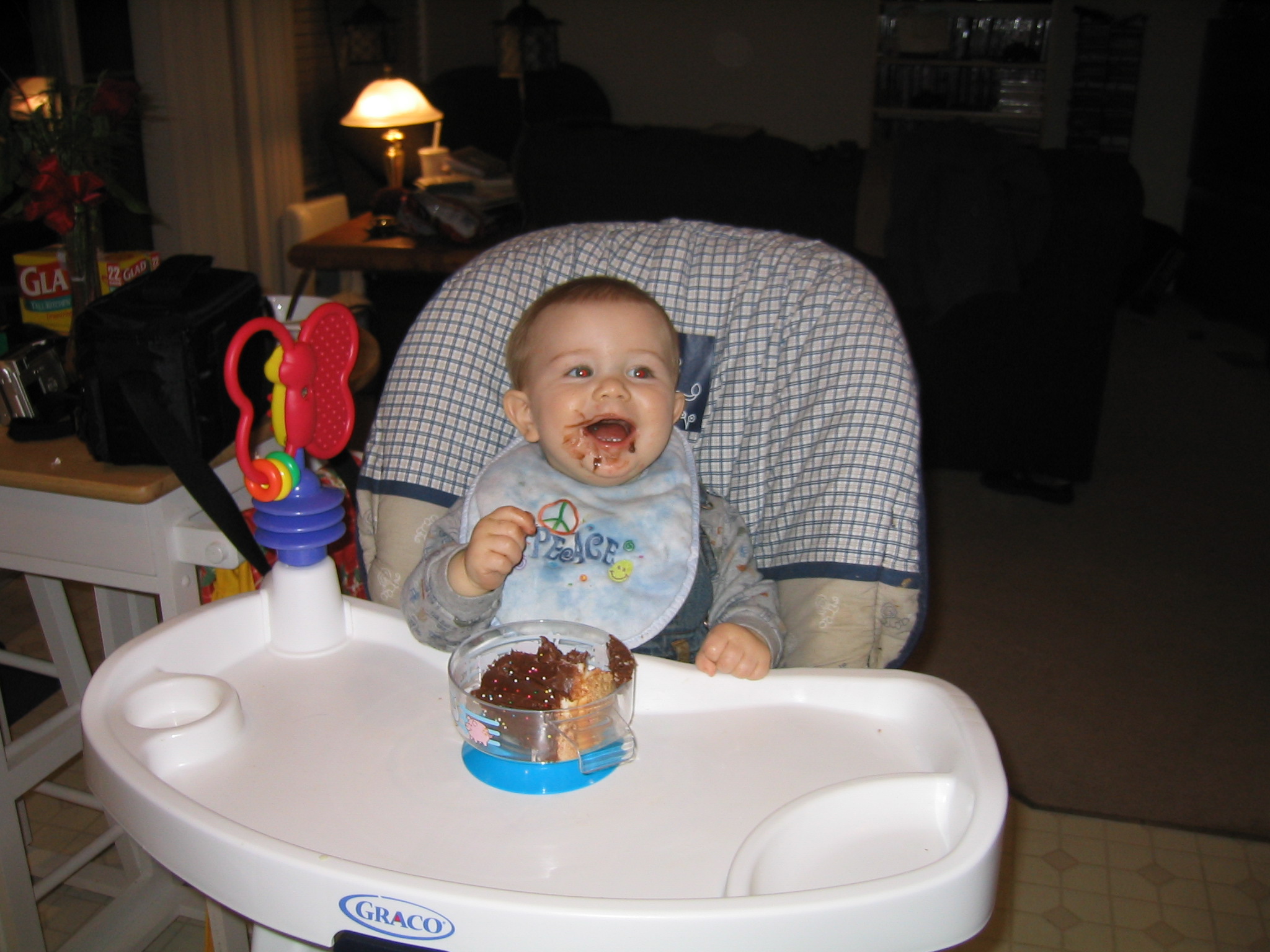
Almost exactly year ago, my life was changed forever by the arrival of my son Patrick. I tried to approach my imending fatherhood with an open mind, realizing that my life was going to change but not really sure exactly how. So far, I think I’m doing pretty well. Today, Patrick is walking (in spurts), talking (in gibberish mostly), eating solid foods and otherwise making everyone around him smile. I don’t write as much code, play as much XBOX or read for fun as much as I used to, but I do seem to smile a lot more.
I am truly blessed to have such an amazing wife, son and job.